
Why Your AC Temperature Setting Is Costing You More Than It Should
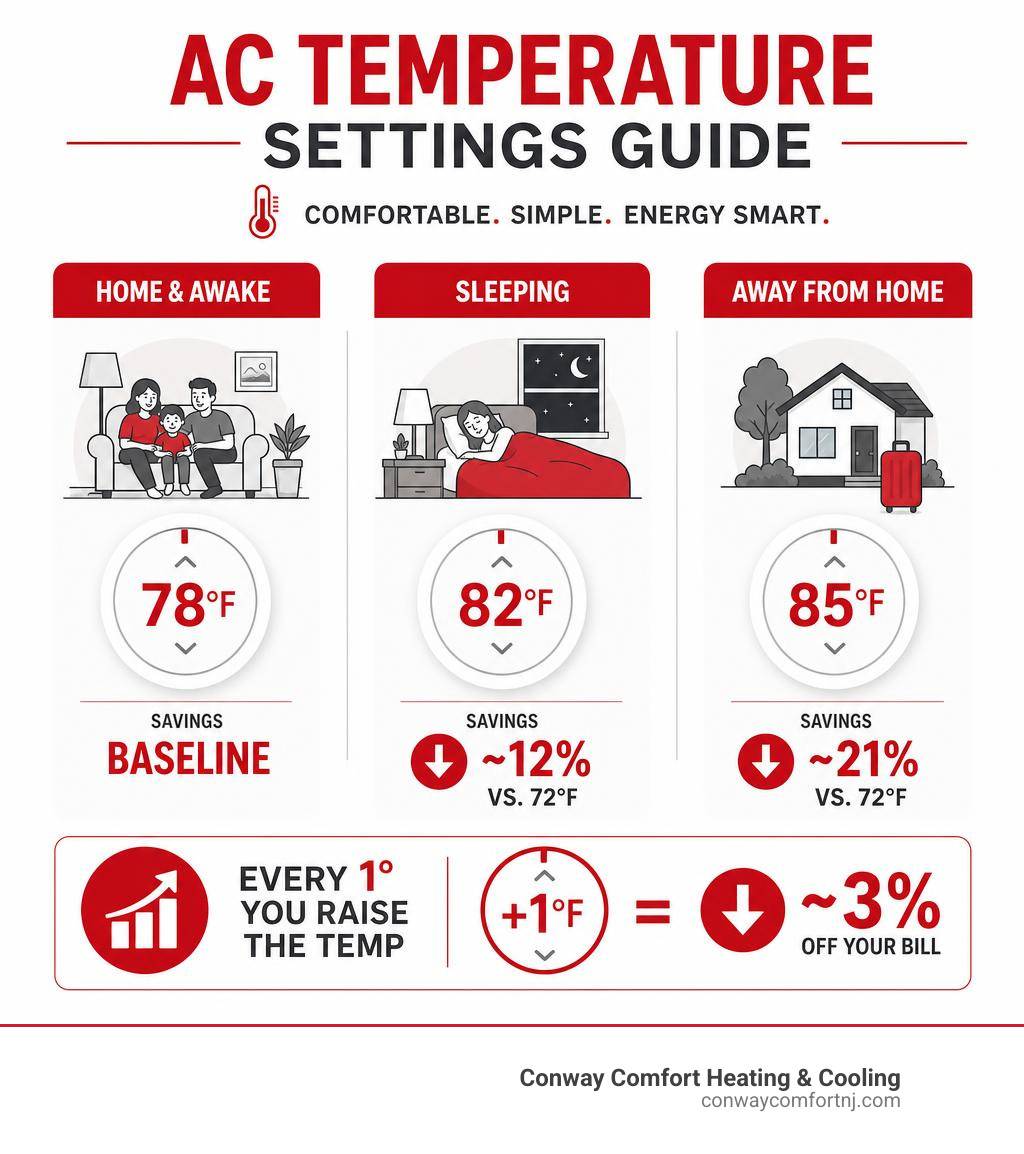
The best AC temperature for energy saving is 78°F when you’re home and awake — and adjusting from there based on whether you’re asleep or away can cut your cooling bill by up to 10% a year.
Here’s the quick-reference guide:
| Situation | Recommended Setting | Estimated Savings |
|---|---|---|
| Home and awake | 78°F | Baseline |
| Sleeping | 82°F | ~12% vs. 72°F |
| Away from home | 85°F | ~21% vs. 72°F |
| Every 1° you raise the temp | +1°F | ~3% off your bill |
Summer in New Jersey hits hard. When outdoor temps climb into the 90s, your first instinct is to crank the AC down as low as it will go. But that single decision — setting your thermostat to 68°F instead of 78°F — could be adding hundreds of dollars to your annual energy bill without making your home noticeably more comfortable.
The good news? A few simple, no-cost adjustments to your thermostat settings can make a real dent in your utility bills without making you sweat it out.
I’m Brian Conway, owner of Conway Comfort Heating & Cooling, and after more than a decade helping homeowners across Hamilton Township, NJ find the best AC temperature for energy saving, I’ve seen how small thermostat changes lead to big savings on monthly bills. In this guide, I’ll walk you through exactly what to set — and why it works.
Finding the Best AC Temperature for Energy Saving When You Are Home
When you are relaxing at home in Mercer County on a sticky July afternoon, what is the magic number on the thermostat?
According to federal guidelines from the Department of Energy and Energy Star, setting your thermostat to 78°F (26°C) while you are home and awake is the optimal starting point. This setting strikes the perfect balance between keeping your indoor spaces comfortable and preventing your utility bills from skyrocketing.
However, we know what you might be thinking: “78 degrees? Are you trying to turn my living room into a sauna?”
It’s a common reaction. In fact, real-world consumer data shows that the average temperature Americans actually keep their thermostats set to is about 71°F during both the day and night. Interestingly, there are distinct regional differences:
- The South: Residents in hotter southern climates tend to keep their day settings slightly higher, averaging around 72°F during the day and 71°F at night.
- The Northeast: Here in New Jersey and the surrounding states, residents tend to keep things cooler, often averaging 70°F day and night.
If you are used to keeping your home at 70°F, jumping straight to 78°F can feel like a shock to the system. That is why we recommend a gradual approach. Try raising your thermostat by just 1°F at a time over a few days. This allows your body to naturally adjust to the change. You will likely find that 75°F to 78°F feels perfectly pleasant once your body acclimates.
The Best AC Temperature for Energy Saving While You Sleep
When the sun goes down, your body’s internal temperature naturally drops as you prepare for sleep. This biological shift means you can actually tolerate a warmer room overnight than you might think.
For the maximum possible savings, the Department of Energy recommends setting your AC to 82°F while you sleep. While this might sound warm, the Physics of body heat radiation and AC settings explains why it works. According to physics experts, your body radiates excess heat to the surrounding environment to cool itself down. As long as the indoor air temperature is comfortably below your normal skin temperature (which is typically around 91°F to 93°F), your body can still successfully shed heat.
To make an 82°F sleep setting feel incredibly comfortable, we highly recommend running a ceiling fan in your bedroom. The fan doesn’t cool the room itself, but it creates a “wind chill effect” across your skin. This constant airflow speeds up the evaporation of moisture from your body, making the room feel up to 4°F cooler than the actual thermostat reading. Just remember: fans cool people, not rooms, so turn them off when you leave!
The Best AC Temperature for Energy Saving When You Are Away
One of the biggest wastes of money in Central New Jersey is cooling an empty house. If you are heading out to work, school, or a day trip to Princeton, there is absolutely no reason to keep your air conditioner running at its occupied setting.
When you are away from home for 4 hours or more, you should set your thermostat to 85°F. Keeping the indoor temperature closer to the outdoor temperature significantly slows down the rate at which heat enters your home.
We call this the “setback” strategy. By allowing your home to warm up to 85°F while you are gone, you prevent your AC compressor from cycling on and off all day to maintain an unnecessarily cool temperature. When you return, a modern, properly sized AC system will only take a couple of hours to bring the temperature back down to your comfortable living range.
The Math Behind Thermostat Adjustments and Utility Bill Savings
Let’s look at the actual numbers to see how much cash you are burning by keeping your home too cold.
As a general rule of thumb, you will save about 3% on your cooling costs for every single degree you raise your thermostat setting over a 24-hour period. If you implement a setback of 7 to 10 degrees for at least 8 hours a day (for example, while you are at work), you can save up to 10% annually on your heating and cooling bills.
To put this into perspective, let’s look at a typical summer billing cycle in Hamilton Township, NJ:
| Thermostat Setting | Average Monthly Cooling Cost | Estimated Annual Savings |
|---|---|---|
| 71°F (Standard Comfort Setting) | $200.00 | Baseline |
| 74°F (Moderate Savings) | $182.00 | $90.00 / year |
| 76°F (High Savings) | $170.00 | $150.00 / year |
| 78°F (Maximum Efficiency) | $158.00 | $210.00 / year |
Your exact savings also depend on how efficient your equipment is. Older air conditioners often have lower SEER ratings, which means they use more electricity to deliver the same cooling. If you’re not sure what those efficiency numbers mean for your monthly bill, here’s a simple breakdown of how HVAC efficiency ratings work.
The industry has also moved to tougher efficiency standards. If you’re curious how newer high-efficiency systems can reduce energy use even more, here’s a simple breakdown of what SEER2 means for homeowners.
How Smart and Programmable Thermostats Maximize Your Efficiency
Let’s face it: manually adjusting your thermostat four times a day is a hassle. It is incredibly easy to forget to turn the AC up before you leave for work, which means you end up paying to cool an empty house all day.
This is where technology comes to the rescue. Installing a programmable or smart thermostat is one of the easiest and most cost-effective ways to automate your energy savings.
- Programmable Thermostats: These units allow you to set a fixed schedule based on your routine. You can program a “wake” temperature, an “away” temperature, a “return” temperature, and a “sleep” temperature. Once set, you don’t have to think about it again.
- Smart Thermostats: Taking efficiency a step further, smart thermostats connect to your home’s Wi-Fi. They can “learn” your daily habits over time, automatically adjusting the temperature when they detect that the house is empty. Plus, you can control them remotely from your smartphone—perfect for turning the AC down when you are on your way back from a trip.
For a deeper look at how these devices can lower your energy costs, see our guide to saving with smart thermostats and our tips for staying comfortable with smarter cooling.
Beyond the Thermostat: No-Cost Habits to Boost AC Efficiency
Adjusting your thermostat is the most effective way to lower your energy bills, but it isn’t the only tool at your disposal. You can drastically reduce the workload on your air conditioner—and keep your home feeling cooler at higher temperature settings—by adopting a few simple, no-cost daily habits.
- Manage Your Windows and Blinds: Direct sunlight through your windows acts like a giant heater. Close blinds, shades, or curtains on south- and west-facing windows during the hottest parts of the day to reduce unwanted solar heat and help your AC run less often.
- Use the Wind Chill Effect: Run ceiling fans in the rooms you are actually using. Set the blades to spin counter-clockwise in summer so they push a cooling breeze downward.
- Avoid Heat-Generating Appliances: Your dryer, oven, and dishwasher add heat and humidity indoors. Using them during the hottest part of the afternoon makes your AC work harder, so shift those chores to the evening when possible.
- Leverage Natural Ventilation: On milder spring and summer nights in Central Jersey, turn off the AC and open windows on opposite sides of your home to create a cross-breeze. Close them early in the morning to trap cooler air inside.
- Use Local Energy-Saving Guidance: Keep an eye on local utility recommendations and conservation alerts. They can help you adjust daily habits, avoid peak energy waste, and keep your overall cooling costs under control.
Essential HVAC Maintenance for Peak Summer Performance
You can set your thermostat to the most efficient temperature possible, but if your air conditioning system is dirty or neglected, it will still consume excessive amounts of energy. Regular maintenance is non-negotiable if you want to keep your utility bills low and prevent sudden, costly breakdowns.
First and foremost, change your air filters regularly. A dirty, clogged air filter restricts airflow, forcing your AC blower motor to work significantly harder to pull air through the system. This not only spikes your electricity usage by 5% to 15%, but it can also cause your system to overheat or freeze up. We recommend checking your filter monthly and replacing it at least every 90 days—or every 30 days if you have pets or allergy sufferers in your home.
Second, schedule an annual professional tune-up before the summer heat waves arrive. A certified technician will clean your outdoor condenser coils, check refrigerant levels, calibrate your thermostat, and inspect electrical connections to ensure peak operating efficiency.
To make sure your system is ready before the hottest days arrive, use our summer AC maintenance checklist. If you want fewer surprise costs over time, it’s also worth seeing how a maintenance plan can help protect your budget.
Frequently Asked Questions About AC Energy Savings
Is it better to leave the AC on all day or turn it off when away?
This is one of the most common debates among homeowners. Many believe that turning the AC completely off while they are at work forces the system to “work harder” and consume more energy to cool the house back down when they return.
However, the physics of heat transfer proves otherwise. Heat naturally flows from warmer areas to cooler areas. The colder your house is inside, the faster heat from the outdoors will penetrate your walls and windows. By raising the thermostat or turning the system off when you leave, you slow down this heat transfer.
As experts note when explaining this simple AC temperature trick, your system does not cool faster just because you set the thermostat much lower. So when you are away, raising the temperature or turning the AC off is usually the more efficient move, as long as your home is insulated well enough to avoid extreme heat buildup.
How does humidity affect my ideal thermostat setting?
In New Jersey, it’s rarely just the heat—it’s the humidity. High humidity levels prevent sweat from evaporating efficiently from your skin, making the indoor air feel much warmer and stickier than the thermometer actually reads.
Your air conditioner naturally removes moisture from the air as it cools. However, if your home still feels muggy at 78°F, you might find yourself instinctively lowering the thermostat to 72°F just to feel dry. This is a costly habit.
Instead of lowering the temperature, try utilizing your AC’s “dehumidifier mode” (if equipped) or running a standalone dehumidifier. Keeping your indoor relative humidity between 45% and 55% allows you to keep the thermostat set to a higher, more efficient temperature while still feeling perfectly cool and comfortable.
What are the best settings for window or portable AC units?
If you live in an older home or a rental apartment in Trenton or Bordentown without central air, you likely rely on window or portable AC units. Because these units only cool localized spaces, your strategy should be slightly different.
First, avoid cooling empty rooms. Only turn on bedroom window units about 30 minutes before you plan to go to sleep rather than running them all day. Second, be aware of thermostat placement. Window units have their temperature sensors built into the machine itself, which is right next to the cold air output. This can cause the unit to cycle off prematurely before the far side of the room is actually cool.
Conclusion
Finding the best AC temperature for energy saving doesn’t mean you have to suffer through a miserable, sweaty summer. By setting your thermostat to 78°F when you are home, utilizing setbacks when you are away or sleeping, and keeping up with basic system maintenance, you can keep your home comfortable while keeping your hard-earned cash in your wallet.
At Conway Comfort Heating & Cooling, we are proud to serve families and businesses throughout Hamilton Township, NJ, and surrounding Mercer County communities like Lawrence, Princeton, and East Windsor. We are committed to providing transparent pricing, honest advice, and 24/7 customer-focused service to keep your cooling systems running flawlessly all summer long.
Ready to take control of your energy bills and automate your summer savings? Upgrade to a Smart Thermostat today or contact our friendly team to schedule your seasonal AC tune-up!