
When Your Commercial HVAC Goes Down, Every Minute Costs You Money
Commercial HVAC emergency service is the 24/7 rapid-response support businesses need when heating or cooling systems fail unexpectedly — threatening safety, operations, and revenue.
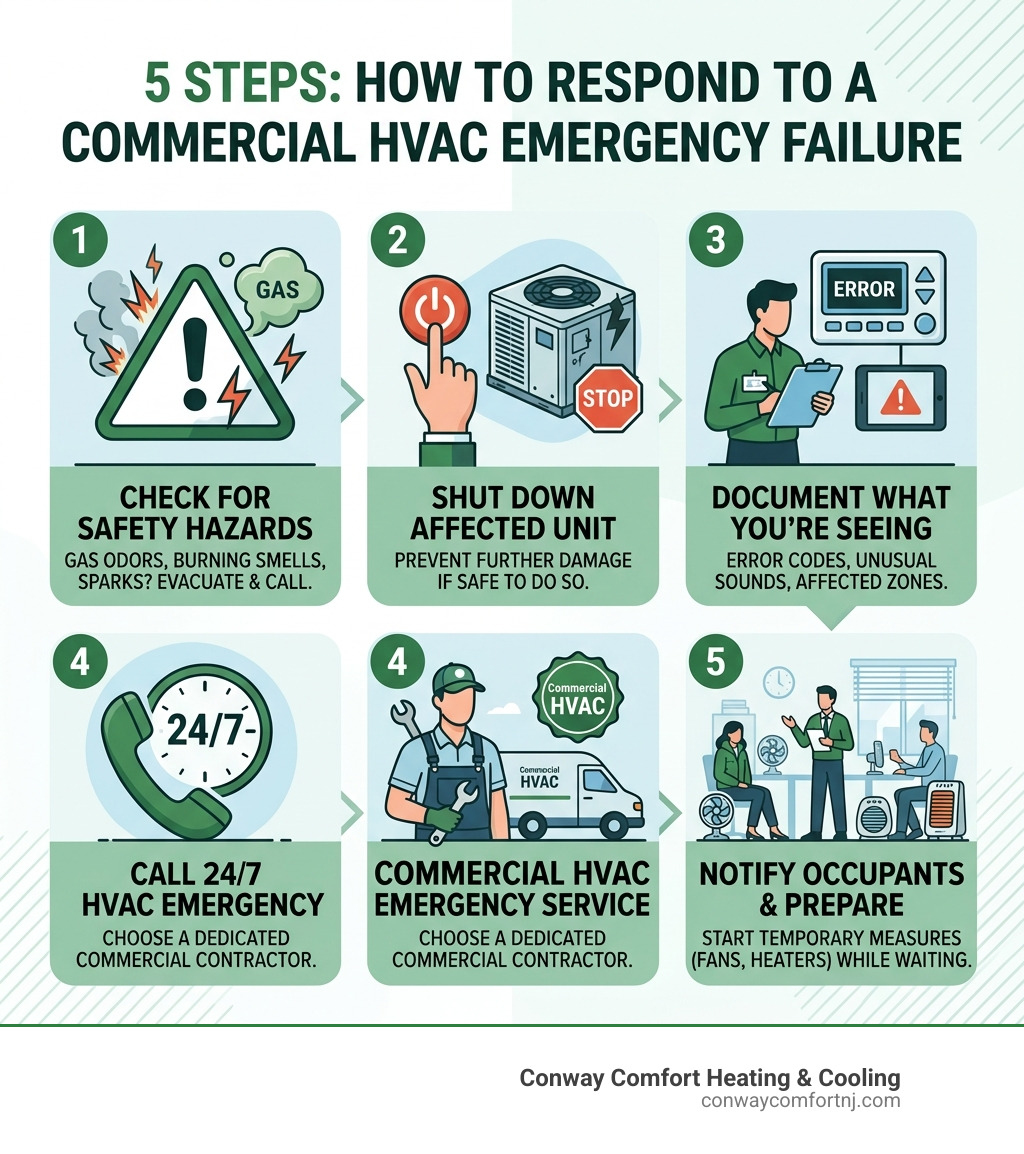
Here’s what to do right now if your commercial HVAC system has failed:
- Check for safety hazards first — gas odors, burning smells, or visible sparks mean evacuate and call immediately
- Shut down the affected unit if it’s safe to do so, to prevent further damage
- Document what you’re seeing — error codes, unusual sounds, which zones are affected
- Call a 24/7 commercial HVAC emergency service — not a residential contractor
- Notify occupants or tenants and begin any temporary measures (fans, space heaters) while you wait
When a commercial HVAC system fails, the impact is immediate. Employees can’t work in extreme heat or cold. Customers leave. Temperature-sensitive inventory can be ruined. In some facilities — like healthcare offices or data centers — a failure isn’t just uncomfortable, it’s a compliance and safety crisis.
The problem is that most HVAC breakdowns don’t happen at 9 a.m. on a Tuesday. They happen on a Friday night, during a holiday weekend, or in the middle of a summer heat wave — exactly when your building needs it most. According to industry data, 94% of emergency HVAC breakdowns occur in systems that weren’t regularly maintained — meaning most of these crises are preventable.
I’m Brian Conway, owner of Conway Comfort Heating & Cooling, and over the past 13+ years serving commercial properties in Hamilton Township and the surrounding New Jersey area, I’ve responded to more commercial HVAC emergency service calls than I can count. This guide walks you through exactly how to handle a breakdown calmly and effectively — so you can protect your business and get back to normal fast.
Identifying a True Commercial HVAC Emergency Service Need
Not every HVAC hiccup requires a midnight phone call, but in a commercial setting, the line between “annoyance” and “emergency” is often drawn by safety and the bottom line. A true commercial HVAC emergency service need is defined by any situation that poses a risk to people, property, or business continuity.
Safety Risks and Immediate Hazards
Safety is always the first priority. If you smell gas (a rotten egg odor), you must evacuate the building immediately and contact both the gas company and an emergency technician. Similarly, a burning smell or visible sparks from a rooftop unit (RTU) indicate an electrical hazard that could lead to a fire.
Refrigerant leaks are another serious concern. Beyond the environmental impact, large leaks can cause “compressor burnout,” turning a repairable issue into a total system replacement. If you hear hissing sounds or see ice forming on copper lines during a humid New Jersey summer, your system is crying for help.
Operational and Financial Emergencies
For many of our clients in Mercer County, the “emergency” is the loss of critical infrastructure.
- Data Center Cooling: Servers generate immense heat. Without precise climate control, hardware can fry within minutes, leading to catastrophic data loss.
- Healthcare Compliance: Medical offices and clinics must maintain specific temperatures to protect medicine, vaccines, and patient safety.
- Temperature-Sensitive Inventory: Restaurants and food service providers risk thousands of dollars in spoilage if the air conditioning or refrigeration fails during a heatwave.
- Property Damage: During a freezing Hamilton winter, a failed heating system can lead to frozen pipes, causing massive water damage to your facility.
If your business is facing a complete system shutdown, you aren’t just losing comfort—you’re losing money.
When to Call for Emergency Commercial HVAC Service
We often tell our customers that if the problem can’t wait until 8:00 AM Monday without causing significant harm, it’s an emergency. Specific triggers include:
- Carbon Monoxide Risks: If your CO detectors are sounding or occupants are reporting headaches and nausea, shut down the furnace immediately. Knowing when to call emergency furnace repair can literally save lives.
- No Airflow During Extreme Weather: If it’s 95°F outside and your vents are silent, your building will become a greenhouse in hours.
- High-Occupancy Events: A church, school, or retail space with hundreds of people inside cannot safely operate without ventilation.
Critical Risks of Delaying Commercial HVAC Repairs
Tempting as it may be to wait for standard business hours to avoid “after-hours” fees, the delay often costs more in the long run.
- Revenue Loss: Customers won’t stay in a freezing restaurant or a sweltering store.
- Employee Productivity: Studies show productivity drops significantly when office temperatures move outside the 68–76°F range.
- Mold Growth: In New Jersey’s humid summers, a failed AC means skyrocketing indoor humidity, which can trigger mold growth in as little as 24 to 48 hours.
- Habitability Concerns: For multi-family property managers, a lack of heat is a legal habitability issue that can lead to tenant lawsuits or city fines. Following basic emergency heating repair tips can help stabilize the situation, but professional intervention is mandatory.
Immediate Steps to Minimize Damage and Downtime
When the system fails, the facility manager’s goal is stabilization. Here is how we recommend you handle the first 30 minutes of a breakdown.
Power Isolation and Safety Protocols
If you suspect an electrical or gas issue, locate your main disconnects or shut-off valves. If it is safe to do so, turning off the power to a malfunctioning unit prevents “collateral damage”—where a small mechanical failure leads to a motor burnout or electrical fire.
Documenting Symptoms and Error Codes
Before you call us, take a quick walk-through.
- Is the thermostat display blank?
- Are there specific error codes (like “E1” or “Limit Switch Open”) flashing on the controller?
- Is the outdoor fan spinning?
- Are you hearing grinding, screeching, or thumping?
Having this information ready helps our dispatch team prioritize your call and ensures our technicians bring the right parts. You can get your AC emergency diagnosed today much faster if we know what we’re looking for before we arrive.
Communicating with Your Commercial HVAC Emergency Service Provider
When you call for commercial HVAC emergency service, don’t just leave a message on a general voicemail. At Conway Comfort, we emphasize direct communication. When speaking with a provider, provide:
- System Type: Is it a rooftop unit, a split system, or a boiler?
- Model/Serial Numbers: Usually found on a silver “data plate” on the side of the unit.
- Site Access: Does the technician need a roof hatch key? Is there a security gate code?
- Priority Status: Explain if this is a “mission-critical” area like a server room or a patient care area.
Why Commercial HVAC Failures Require Specialized Expertise
One of the biggest mistakes a business can make is calling a “neighborhood handyman” or a strictly residential contractor for a commercial crisis. Commercial systems are not just “bigger versions” of home AC units; they are complex, integrated machines.
| Feature | Residential HVAC | Commercial HVAC |
|---|---|---|
| Placement | Ground level or attic | Often rooftop-mounted (RTUs) |
| Complexity | Single-stage cooling | Multi-stage, VRF, or Chilled Water |
| Ventilation | Natural infiltration | Dedicated Make-up Air Units (MAUs) |
| Controls | Simple wall thermostat | Building Automation Systems (BAS) |
| Drainage | Simple gravity drain | Complex condensate pump systems |
Commercial technicians need specialized tools, such as heavy-duty manifold gauges, combustion analyzers for large boilers, and the ability to work with 3-phase electrical power. Furthermore, certifications like NATE (North American Technician Excellence) ensure the tech understands the specific physics of large-scale air distribution and commercial HVAC inspection frequency requirements.
Whether it’s troubleshooting a Variable Refrigerant Flow (VRF) system in Princeton or repairing industrial ventilation in a Trenton warehouse, the expertise required is significant.
Preventing Future Breakdowns Through Proactive Maintenance
The most stressful emergency is the one that could have been avoided. As mentioned earlier, 94% of emergency breakdowns occur on non-maintained systems.
The Value of Preventive Maintenance
Commercial properties with comprehensive maintenance programs experience 60-70% fewer emergency HVAC failures. Regular service isn’t just about changing filters (though that’s vital for protecting blower motors); it’s about catching the small stuff.
- A worn belt costs $20 to replace during a tune-up. If it snaps on a Saturday, it results in a $400 emergency call.
- A “pitted” contactor can be spotted months before it fails and causes a total system shutdown.
What Service Contracts Typically Include
A solid commercial maintenance agreement provides budget predictability. Instead of volatile, unexpected repair bills, you have a fixed annual cost. These contracts typically include:
- Priority Status: Contract customers usually move to the front of the line during heatwaves.
- Detailed Reporting: Documentation that helps you plan for future capital expenditures (knowing when a unit is reaching its 15-year lifespan).
- System Optimization: Cleaning coils and calibrating controls can significantly lower your utility bills.
If you’ve dealt with late night heating problems in the past, a maintenance plan is your best insurance policy against a repeat performance.
Frequently Asked Questions about Commercial HVAC Emergencies
How much does a commercial HVAC emergency repair cost?
Pricing for commercial HVAC emergency service varies based on the time of day, the complexity of the system, and the parts required. At Conway Comfort, we believe in transparent pricing. You should expect a diagnostic fee (sometimes higher for after-hours or holidays) plus the cost of labor and parts. Factors that influence price include:
- Site Conditions: Is the unit easily accessible, or does it require a crane or specialized scaffolding?
- Part Availability: Common parts like capacitors or contactors are usually on our trucks, but specialized control boards may require expedited shipping.
- After-Hours Fees: Most companies charge a premium for technicians working 2:00 AM on a Sunday. However, this is often a fraction of the cost of losing a day of business.
What is the typical response time for a 24/7 technician?
While every company is different, a reliable provider should aim for a four-hour response window. For mission-critical emergencies, we strive for same-day service. Maintenance contract customers often receive “priority dispatch,” ensuring they are the first stop of the day. Our coverage across Hamilton, Princeton, and East Windsor allows us to get to most Mercer County businesses quickly.
Can emergency services handle specialized facilities like data centers or restaurants?
Yes, but you must ensure the provider has “industrial expertise.”
- Restaurants: Need technicians who understand make-up air and heavy grease loads on exhaust fans.
- Data Centers: Require “mission-critical” cooling knowledge and an understanding of redundancy systems.
- Healthcare: Must follow strict IAQ (Indoor Air Quality) and filtration standards.
Conclusion: Business Protection and Peace of Mind
An HVAC breakdown doesn’t have to be a disaster. By staying calm, following safety protocols, and having a trusted commercial HVAC emergency service partner on speed dial, you can minimize downtime and protect your bottom line.
At Conway Comfort Heating & Cooling, we’ve spent years helping Hamilton Township business owners navigate these crises with transparent pricing and expert, 24/7 service. Whether you’re running a school in Bordentown or a retail shop in Princeton, we’re here to ensure your doors stay open and your occupants stay comfortable.
Don’t wait for the next heatwave to find out if your system is at risk. Contact our commercial HVAC experts today to schedule an inspection or learn more about our preventive maintenance plans. We’re ready to help you keep your cool—no matter what the New Jersey weather throws your way.