
Why Evaporator Coil Pressure Issues Shut Down Your AC When You Need It Most
Evaporator coil pressure issues are one of the most common reasons HVAC systems stop cooling effectively, and they are also among the most frequently misdiagnosed. Before diving deep, here is a quick summary of what causes them and what to watch for:
Common evaporator coil pressure problems at a glance:
- Low suction pressure: This is typically caused by a low refrigerant charge, a dirty coil, or a failing metering device.
- High static pressure drop across the coil: This occurs when dirt, debris, or blocked airflow restricts the coil surface.
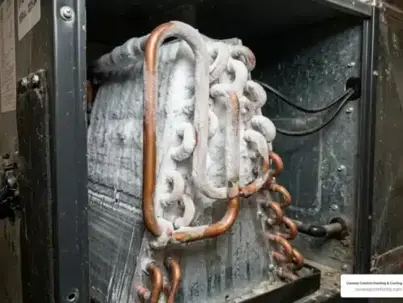
- Frozen evaporator coil: This results from low airflow or low refrigerant, which drops the coil temperature below freezing.
- Partial coil cooling: Only part of the coil gets cold, often due to oil logging or a restricted metering device.
- Overcharge symptoms: Too much refrigerant causes uneven pressure, frozen coils, and compressor stress.
Normal suction pressure ranges: 60-85 psig for R-22, and 120-145 psig for R-410A. Readings outside these ranges almost always point to a problem that needs attention.
If your AC is running but not cooling, icing up, or cycling longer than usual, a pressure problem at the evaporator coil is a likely culprit. Left unchecked, these issues put serious strain on your compressor, which is the most expensive component in your system.
This guide walks you through the causes, diagnostic steps, and repair decisions you need to make before a small pressure problem turns into a full system failure.
I’m Brian Conway, owner of Conway Comfort Heating & Cooling, and since founding the company in 2011 I’ve diagnosed and repaired hundreds of systems in Hamilton Township, NJ where evaporator coil pressure issues are among the most common calls we receive. I’ll walk you through exactly what we look for in the field so you can understand what’s happening in your system and make smart decisions.
Common Causes of Evaporator Coil Pressure Issues
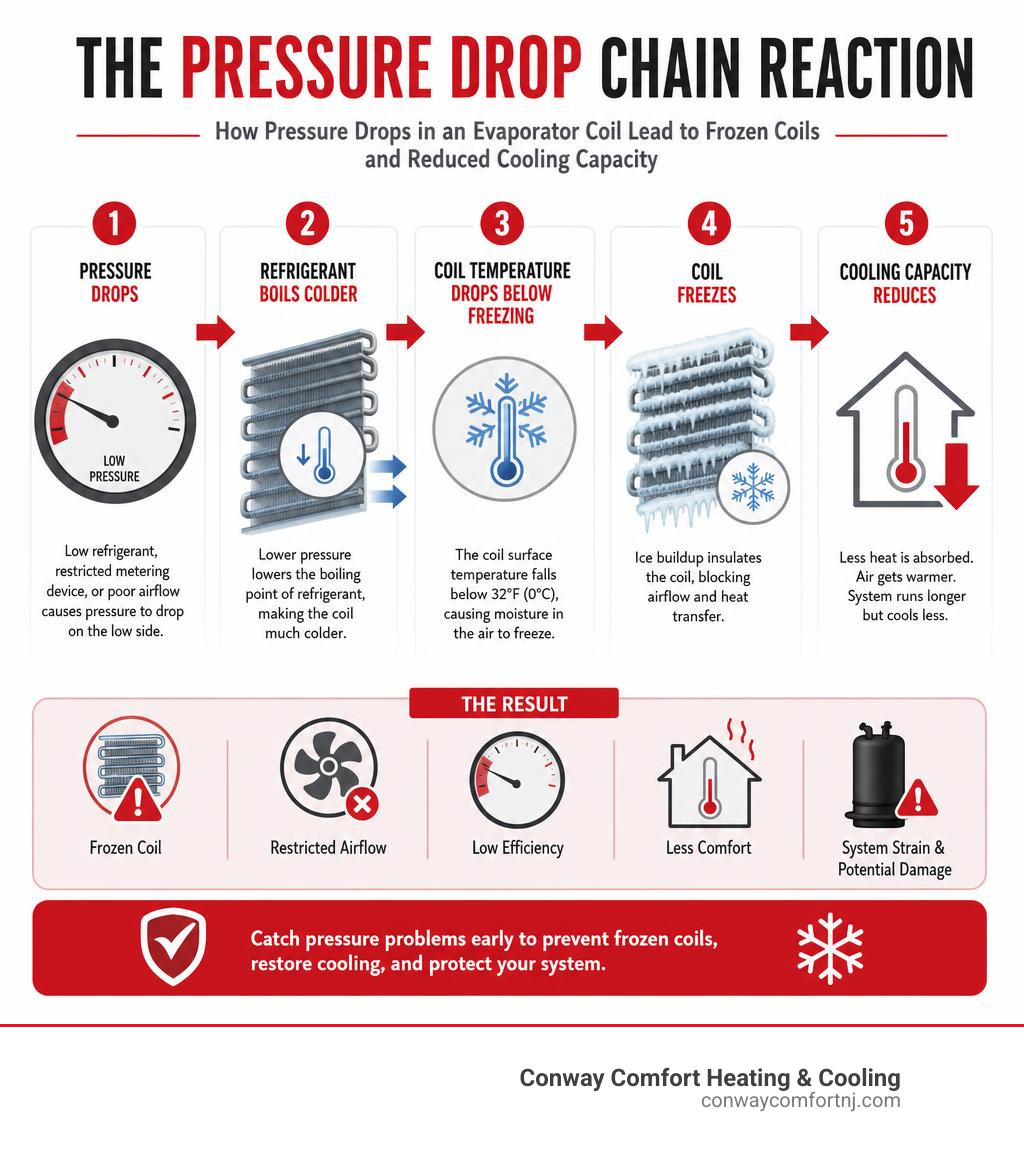
To understand why evaporator coil pressure issues occur, we have to look at the delicate balance between airflow and refrigerant. The evaporator coil acts as a heat exchanger, absorbing heat from your indoor air into the cold refrigerant flowing inside. If either the airflow or the refrigerant flow is disrupted, the pressure inside the low side of the system changes instantly.
When things go wrong, technicians often look for visual cues first. However, to properly identify AC evaporator coil issues, we must connect pressure gauges and analyze the system’s low-side suction pressure. Normal suction pressure ranges vary by refrigerant. For older R-22 systems, normal suction pressure is typically 60 to 85 psig. For modern R-410A systems, it ranges from 120 to 145 psig. If pressure drops below these normal thresholds, the temperature of the refrigerant drops below 32°F, causing any moisture on the coil to freeze.
When suction pressure drops too low, it is usually due to a lack of heat transfer. If the refrigerant cannot absorb enough heat, it does not vaporize fully. This can lead to liquid refrigerant returning to the compressor, causing severe compressor damage. Technicians who understand why low suction pressure happens know that we must look at both airflow and refrigerant delivery to find the root cause.
How Low Airflow Triggers Evaporator Coil Pressure Issues
Airflow is the lifeblood of your air conditioning system. When warm indoor air is restricted, the evaporator coil cannot absorb enough heat. This lack of heat transfer causes the refrigerant pressure and temperature to plummet.
The most common culprits behind low airflow include:
- Dirty Air Filters: A heavily clogged air filter acts like a wall, stopping return air from reaching the coil.
- Undersized or Restressed Ducts: If your ductwork is too small for the size of your AC system, the blower motor cannot push enough CFM (cubic feet per minute) of air across the coil.
- Dirty Blower Wheels: Dust accumulating on the fan blades reduces the motor’s performance and efficiency.
When dirt builds up on the coil fins, it creates a physical barrier that blocks airflow. This highlights the importance of regular evaporator coil cleaning. A dirty coil can cause a static pressure drop of approximately 0.28 inches water column (w.c.) across the coil alone. This restriction starves the system of air, lowers the suction pressure, and forces the blower motor to work much harder, increasing your energy bills.
Refrigerant Leaks and Metering Device Failures
If airflow is completely clear, the pressure issue is likely on the refrigerant side. A refrigerant leak is a very common cause of low suction pressure. In systems that are around 10 years old, a low refrigerant pressure reading (such as 30 psi below normal) with no outdoor leaks is often attributed to tiny pinhole leaks in the indoor evaporator coil. Understanding why your AC is leaking refrigerant is crucial, as corrosion from household chemicals often eats away at the copper tubing over time.
Another common failure point is the metering device, such as a Thermostatic Expansion Valve (TXV) or a capillary tube. The TXV regulates how much refrigerant enters the evaporator coil. If the TXV valve fails or becomes restricted, it under-feeds the coil. This “starves” the coil, causing low suction pressure and high superheat.
Sometimes, oil logging can also mimic a restricted metering device. This happens when compressor oil travels through the lines and gets trapped inside the evaporator coil, blocking refrigerant flow. This is especially common when the outdoor condenser is mounted higher than the indoor evaporator coil without a proper suction line oil trap.
Diagnosing Restricted Coils Without Direct Visual Inspection
In many homes across Central New Jersey, evaporator coils are cased inside metal cabinets or mounted directly on top of upright gas furnaces. This makes a direct visual inspection nearly impossible without cutting open the ductwork. Fortunately, experienced technicians can diagnose a dirty or restricted coil using specialized tools and system measurements.
By using a digital manometer, we can measure the static pressure drop across the coil. If the pressure drop is significantly higher than the manufacturer’s specifications, we know there is an airflow blockage. We also look closely at the temperature drop across the coil, which is the difference between the return air temperature and the supply air temperature. A normal temperature drop is between 15°F and 20°F. If the temperature drop is unusually high (e.g., 25°F or more) and suction pressure is low, it indicates that too little air is moving through the coil. Learning about the common troubles evaporator coils homes experience helps us identify these hidden blockages before they cause a total system breakdown.
Troubleshooting Evaporator Coil Pressure Issues with Superheat and Subcooling
To pinpoint whether a pressure issue is caused by low airflow or a refrigerant problem, technicians must measure superheat and subcooling:
- Superheat is the temperature increase of the refrigerant vapor after it has completely turned from a liquid to a gas.
- Subcooling is the temperature drop of the liquid refrigerant below its saturation temperature before it reaches the metering device.
By comparing these two readings with your suction pressure, we can determine exactly what is happening inside the system:
- Low Suction Pressure + High Superheat + Low Subcooling: This indicates a starved coil, usually caused by a low refrigerant charge or a leak.
- Low Suction Pressure + Low Superheat + Normal/High Subcooling: This points to a flooded coil, which is typically caused by low airflow (dirty filter or dirty coil) or a TXV stuck open.
- Low Suction Pressure + High Superheat + High Subcooling: This indicates a restriction in the liquid line or a restricted TXV that is under-feeding the coil.
Best Practices for Safely Drilling Test Holes
To measure static pressure drop, we must insert static pressure tips into the ductwork before and after the evaporator coil. This requires drilling small test holes in the furnace or air-handler cabinet.
Safety is paramount when drilling. We always follow these best practices:
- Locate Internal Components: Never drill blindly. We inspect the cabinet to locate the heat exchanger, electrical wiring, and the evaporator coil itself to avoid puncturing tubes.
- Use Drill Guards: We use a specialized drill bit guard set to a depth of no more than 1/2 inch to prevent the bit from plunging too deep.
- Drill Near the Supply End: For the downstream reading, we drill into the supply plenum just above the coil casing.
- Seal the Holes: After taking measurements, we always seal the test holes with high-temperature plastic plugs or foil tape to prevent air leaks.
Measuring Static Pressure Drop Across the Coil
Measuring static pressure drop is the most accurate way to verify a clogged coil without pulling the system apart. We use a dual-port digital manometer connected to static pressure tips inserted into our test holes. The manometer measures the pressure before the coil (upstream) and after the coil (downstream). Subtracting the downstream reading from the upstream reading gives us the total pressure drop across the coil.
For example, if we measure 0.45″ w.c. before the coil and 0.15″ w.c. after the coil, the static pressure drop is 0.30″ w.c.
| Coil Design Type | Normal Dry Coil Drop (inches w.c.) | Normal Wet Coil Drop (inches w.c.) | Problematic Drop (Clean Required) |
|---|---|---|---|
| Standard A-Coil | 0.10″ – 0.20″ | 0.15″ – 0.25″ | Above 0.35″ w.c. |
| Slant Coil | 0.12″ – 0.22″ | 0.17″ – 0.28″ | Above 0.40″ w.c. |
| N-Coil / M-Coil | 0.15″ – 0.25″ | 0.20″ – 0.30″ | Above 0.45″ w.c. |
Recommended Static Pressure Drop Values
As shown in the table above, the static pressure drop varies depending on the coil design and whether the coil is wet or dry. A wet coil (one that is actively condensing moisture from the air during cooling) will naturally have a higher pressure drop than a dry coil because the water droplets on the fins restrict a small amount of space. Typically, a wet coil pressure drop is about 0.05″ w.c. higher than a dry measurement.
If your static pressure readings exceed the manufacturer’s maximum specifications (usually 0.40″ to 0.50″ w.c.), it is a clear sign of a severe airflow restriction. This requires professional cleaning to restore proper CFM alignment and prevent system freezing.
Risks and Best Practices for VFDs with Evaporator Fan Motors
In modern commercial and high-end residential HVAC systems, Variable Frequency Drives (VFDs) are used to control the speed of the evaporator fan motor. While VFDs greatly improve energy efficiency, they can introduce unique risks if not set up correctly.
High-frequency switching in VFDs can cause electrical voltage spikes that stress the motor’s winding insulation. To prevent motor failure, technicians should ensure the VFD switching frequency is set to 5 kHz or less. Additionally, for long wiring runs between the VFD and the motor, load-side reactors or dV/dt filters should be installed to condition the voltage. VFDs must also be programmed with “skip frequencies” to prevent the fan from running at speeds that cause harmonic resonance, which can vibrate and damage the evaporator coil.
When to Clean vs. Replace a Failing Evaporator Coil
When your system is struggling with evaporator coil pressure issues, you will eventually face the decision of whether to clean or replace the coil.
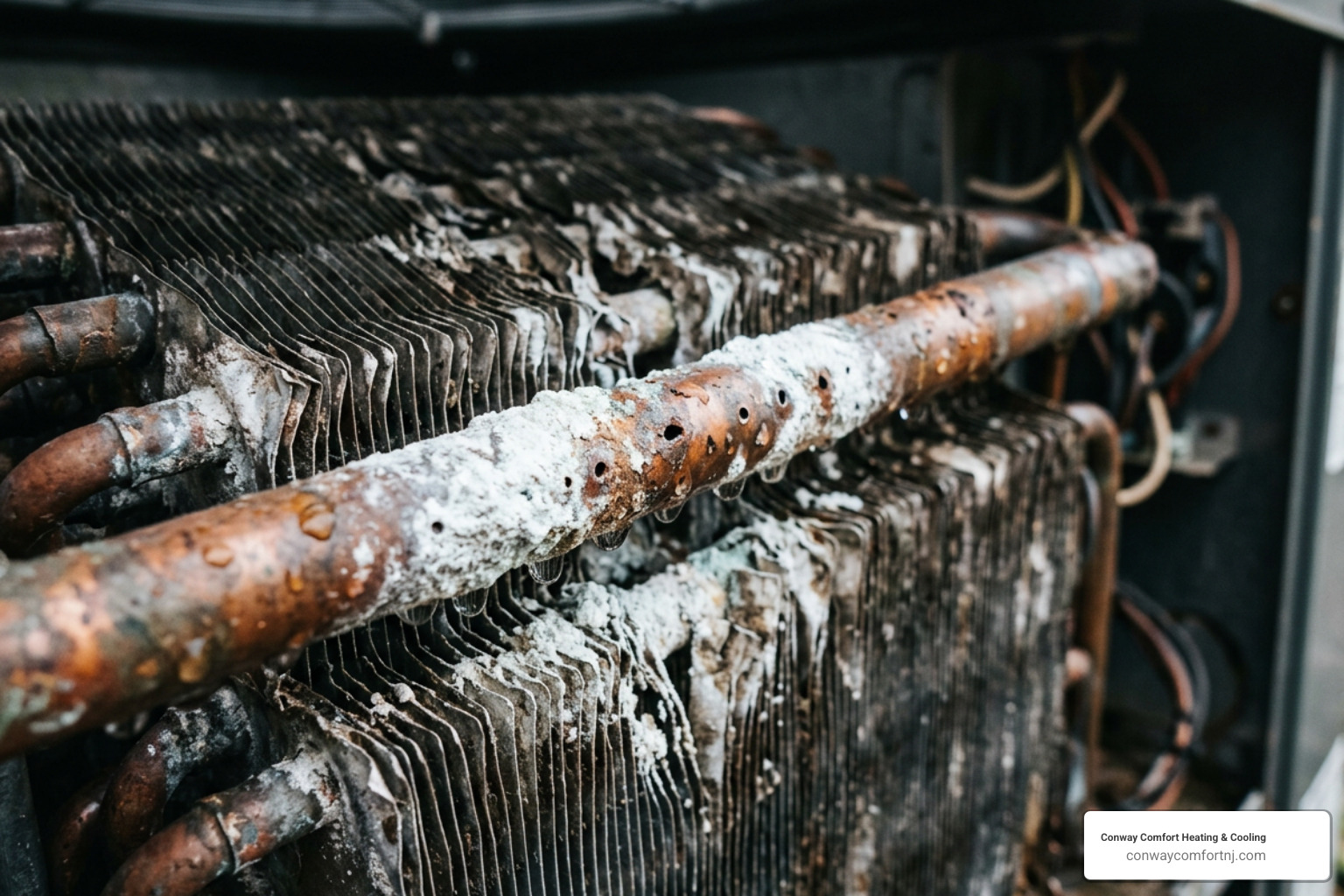
Minor dirt, dust, and pet hair buildup can be easily cleaned. However, if the coil is suffering from severe corrosion (often seen as a white, powdery residue or rust on copper tubes), it will develop microscopic leaks. In these cases, a simple AC repair will not solve the problem long-term. If your system is over 10 years old and uses R-22 refrigerant, replacing the coil alone may not be cost-effective due to the high cost of older refrigerant.
A new evaporator coil should always arrive from the factory under a nitrogen holding charge of 10 to 50 PSI to prove it is leak-free. If a replacement coil arrives “flat” (with zero pressure), it must be pressure tested before installation to protect your warranty.
Cleaning Methods and Preventive Maintenance
For dirty but structurally sound coils, regular maintenance is the key to longevity. We recommend scheduling professional AC maintenance every spring.
Our preventive maintenance steps include:
- Chemical Cleaning: Using self-rinsing, non-acidic foaming cleaners to dissolve dirt deep within the fins.
- Filter Changes: Replacing air filters every 30 to 90 days to prevent dust from reaching the coil.
- Drain Pan Clearing: Cleaning the condensate pan and flush lines to prevent mold growth and water damage.
Safety Precautions for Refrigerant Handling
Diagnosing and repairing refrigerant-related pressure issues requires strict adherence to safety standards. Homeowners should never attempt to handle refrigerant themselves.
Our certified technicians follow all EPA regulations, including using commercial recovery machines to capture refrigerant safely. During pressure testing, we use a dry nitrogen purge to locate leaks and prevent moisture from entering the system. Technicians must always wear safety goggles and heavy-duty gloves, as liquid refrigerant can cause severe frostbite if it contacts bare skin.
Frequently Asked Questions About Evaporator Coil Pressure
What are the symptoms of evaporator coil pressure issues?
Common symptoms include the AC blowing warm air, low low-side suction pressure readings, ice forming on the indoor coil or outdoor refrigerant lines, long system runtimes, and a noticeable spike in monthly utility bills.
What causes low suction pressure in an AC system?
Low suction pressure is typically caused by restricted airflow (dirty filters or dirty coils), a low refrigerant charge due to a leak, or a restricted metering device like a failing TXV.
How does a dirty air filter affect evaporator coil pressure?
A dirty air filter restricts airflow across the evaporator coil. Without enough warm air passing over the coil, the refrigerant inside cannot absorb heat, causing the pressure and temperature of the coil to drop, which leads to ice buildup.
What is a normal static pressure drop across a wet evaporator coil?
A normal static pressure drop across a wet coil typically ranges between 0.15″ and 0.30″ w.c., depending on the coil design and system CFM. Any reading above 0.40″ w.c. generally indicates a dirty or restricted coil.
Can an overcharged AC system cause evaporator coil pressure issues?
Yes. An overcharged system causes high head pressure and can lead to liquid refrigerant flooding back into the compressor. This causes uneven pressure levels, reduced cooling capacity, and can eventually destroy the compressor valves.
How do you diagnose a dirty evaporator coil without looking at it?
Technicians measure the static pressure drop across the coil using a digital manometer. If the pressure drop exceeds manufacturer specs while the system is moving the correct amount of air, the coil is restricted and needs cleaning.
What are the risks of drilling test holes in a furnace cabinet?
The primary risk is puncturing the heat exchanger, the evaporator coil tubes, or internal electrical wiring. Technicians must use drill guards and carefully locate internal components before drilling.
How much does it cost to replace a failing evaporator coil?
The cost to replace an evaporator coil can vary significantly depending on several factors, including the size of your system, the brand of equipment, and the complexity of the installation. Because pricing depends on your specific home and HVAC setup, homeowners should request a professional estimate for accurate pricing in their local area.
Why is only half of my evaporator coil getting cold?
This usually indicates a partial refrigerant flow issue. It can be caused by a restricted metering device, a partial refrigerant charge, or oil logging where compressor oil gets trapped in some of the coil circuits, reducing heat transfer by up to 50%.
How do VFDs affect evaporator fan motor performance?
VFDs allow for energy-saving variable fan speeds. However, they can cause electrical voltage stress on motor windings. Setting the correct switching frequency (5 kHz or less) and using voltage conditioning filters helps protect the motor.
Conclusion
Ignoring evaporator coil pressure issues will eventually lead to a frozen system, high energy bills, and potentially a broken compressor. Whether your system needs a deep chemical cleaning, a TXV adjustment, or a complete coil replacement, addressing these pressure imbalances early is the best way to keep your home comfortable all summer long.
At Conway Comfort Heating & Cooling, we are dedicated to keeping families in Hamilton Township, NJ cool and comfortable. With our transparent pricing and 24/7 customer-focused service, you can trust our certified technicians to diagnose and repair your system correctly the first time.
Whether you need fast AC repairs, seasonal HVAC maintenance, or a complete system replacement, the team at Conway Comfort Heating & Cooling is ready to help. Give us a call and schedule your professional AC evaporator coil services today!